
“Having a vested interest” means having a direct, personal—often financial—stake in an outcome. When the result materially affects you, your decisions change. Accountability sharpens. Priorities shift.
And when one party in a relationship does not have a vested interest in doing the right thing, the outcome will never match what it could have been if they did.
A clear example of this problem is capital improvement projects in public schools.
Today, there is no built-in vested interest between capital designers (architects and engineers) and the long-term performance of what they design. That’s not a criticism of the professionals themselves—most care deeply about their work. But incentives matter. And if architects and engineers were responsible for maintaining and repairing what they design for 10, 15, or 20 years, many of those designs would look very different.
Let me explain why.
The Structural Problem
Fact 1: Capital improvements and maintenance/repairs are managed independently.
Because of this separation, two predictable things happen:
Fact 2: Architects and engineers recommend capital improvements based on initial project goals—not long-term maintenance and repair obligations—because those obligations are not theirs. If they were financially responsible for maintenance and repairs over time, their recommendations would absolutely change.
Fact 3: Once a project is completed, too many administrations deprioritize maintenance and repair expenses tied to those same capital improvements. When budgets tighten, maintenance is often the first thing cut.
If you doubt this, call 100 public school facility directors. You’ll be lucky to find two or three who disagree. This is why they spend their days “putting out fires,” doing everything they can to keep aging buildings safe and healthy with insufficient resources.
A Model That Fixes the Incentives
There is a solution—one that builds a vested interest directly into the funding and delivery model.
It’s a structure where the same entity responsible for designing and installing capital improvements is also contractually responsible for maintaining and repairing them for the full term of the agreement.
This is Smart Air Defense’s version of what some know as Energy Savings as-a-Service (ESaaS)—the next generation of alternative funding for public school infrastructure.
Why This Matters
To understand the urgency, a few realities must be acknowledged:
- Federal funding for public schools has been significantly reduced
- States are struggling to support schools within constrained budgets
- Local communities cannot afford continual tax increases
- K–12 public schools are accumulating debt
According to the 2025 State of Our Schools Report Card (infrastructurereportcard.org):
- During SY 2021–2022, schools invested $79B in capital costs
- To put the debt they carry into perspective, schools spent $22B on debt service
- Of the $79B used for cap costs, $60B was spent on new sites, and only $5.7B (7%) was invested in existing buildings
The same report states:
“Investments at this rate mean the upkeep of buildings is often underfunded and delayed, often to the point where full replacement is needed.”
In plain terms: we are making investments we fail to maintain—shortening asset life and driving up long-term costs.
Think of skipping every other oil change for your car. Eventually, you’re not paying for maintenance—you’re paying for a new engine. That’s exactly what’s happening in our schools.
Why Grants Alone Aren’t Enough
Yes, grants exist—and schools should pursue every dollar available. We actively encourage that. But most grant funding barely scratches the surface of what schools actually need.
The problem is not access to millions. The problem is access to billions.
We cannot rely on federal and or state funding alone. Private capital is essential—and we need a lot of it.
Through relationships built over 30 years, Onsite Utility Services LLC (a co-division of Origyn International) has access to this level of institutional capital. Smart Air Defense is their exclusive partner, bringing this capital into the public school market using the ESaaS platform.
How ESaaS Actually Works
At first glance, ESaaS looks similar to a traditional Energy Performance Contract (EPC):
- An engineering firm performs an assessment
- Energy savings fund capital improvements
- No upfront out-of-pocket costs for the school
But the similarities end there.
In most EPCs:
- Savings are guaranteed
- Projects focus on “low-hanging fruit”
- Schools remain responsible for maintenance and repairs
- EPCs are treated as debt and appear on balance sheets
Meanwhile, according to the GAO:
- 41% of districts need HVAC upgrades in at least half their schools
- 28% need major upgrades to lighting, roofs, and safety systems
These are precisely the systems EPCs often can’t fully address.
What Makes ESaaS Different
ESaaS also begins with an ASHRAE Level III (Investment-Grade) Energy Audit, the most rigorous audit available (similar to EPC). But it goes further.
An ESaaS evaluates:
- Energy usage
- HVAC and boiler performance
- Roofing systems
- Building envelope
- Maintenance and repair realities across the entire facility
Because ESaaS does not guarantee savings, it offers flexibility EPCs simply don’t have. Savings from high-performing buildings can be used to address critical needs in buildings that must be fixed—even if they don’t directly reduce energy costs.
Example: If a district has 10 buildings, and 3 require major non-energy repairs, ESaaS can bundle all 10 into one solution. The district may break even on operating expenses—but accomplish critical repairs EPCs can’t touch.
The Financial Breakthrough
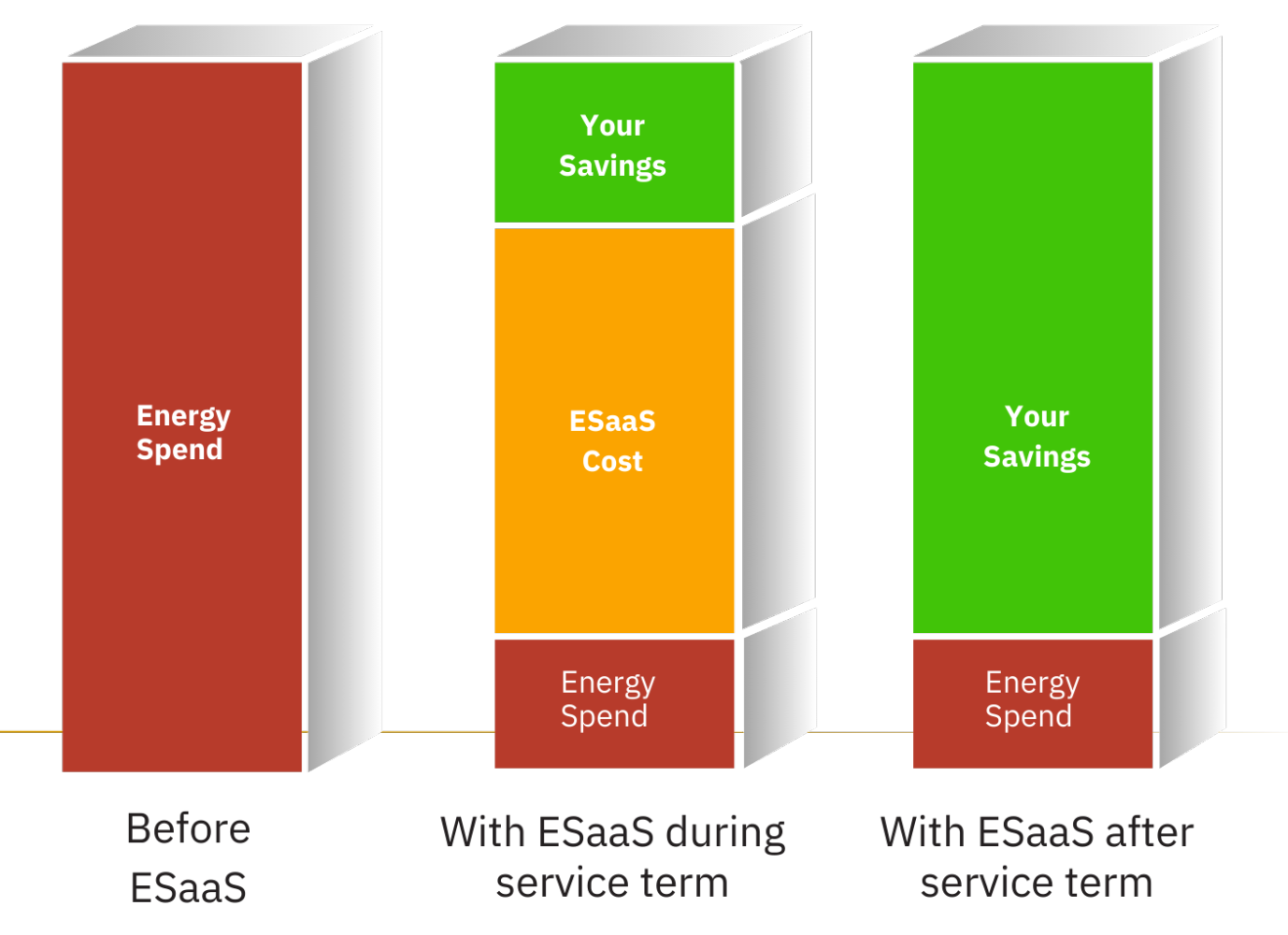
An ESaaS converts capital expenditures into operating expenses.
- It is not debt
- It is not a loan
- It does not appear on the balance sheet
The goal is simple: Make necessary capital improvements while keeping total operating costs at or below historical levels.
What is guaranteed?
- Performance of the installed systems
- Fixed maintenance and repair costs for the term of the contract (5–20 years)
Why This Matters to States
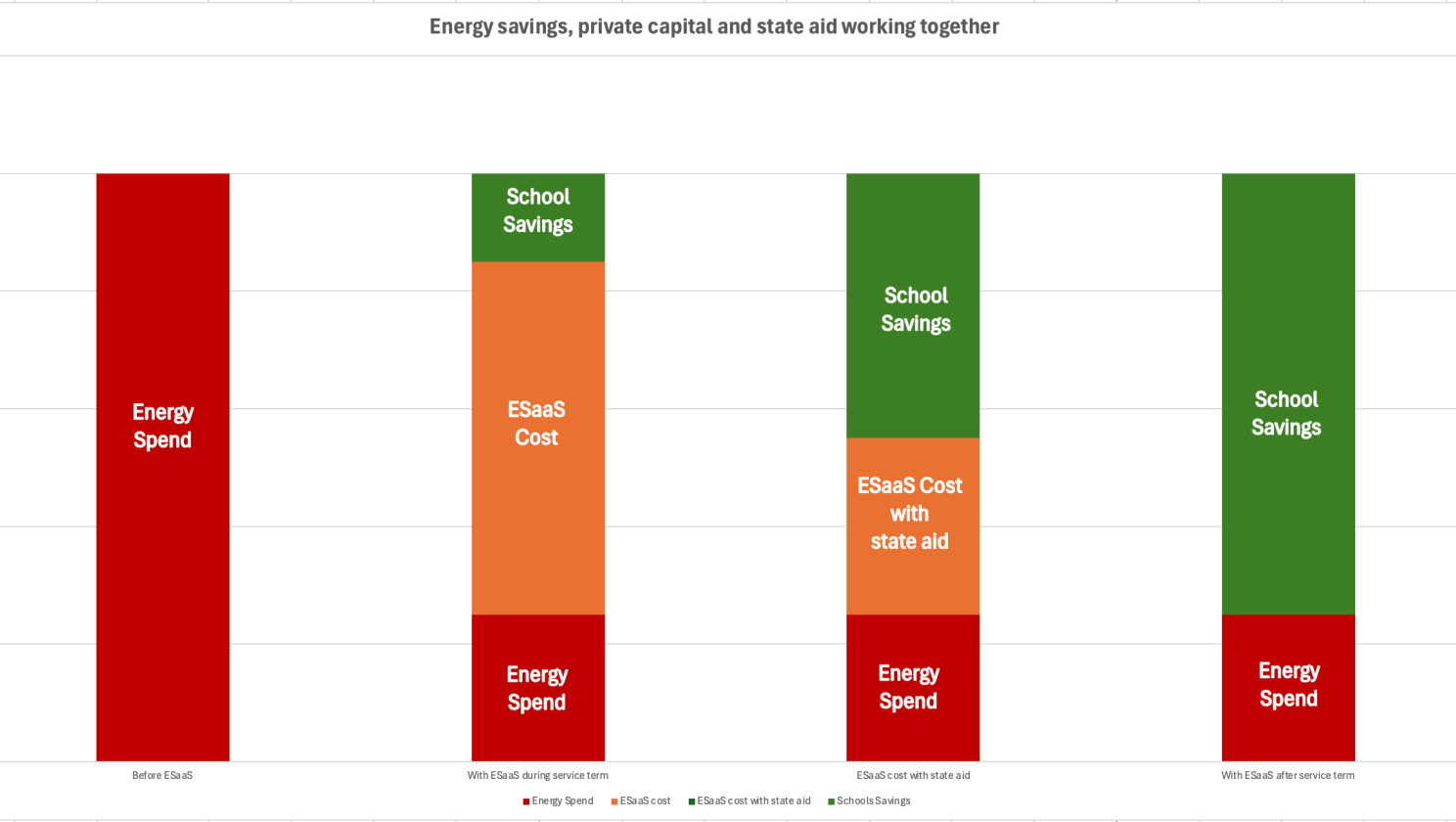
When private capital is paired with state aid:
- State contributions further reduce school operating costs
- Maintenance and repairs are guaranteed—protecting the state’s investments
- States can spread funding over time instead of issuing large lump sums
This is not just smarter for schools—it’s smarter for state budgets.
The Bottom Line
Schools don’t fail because people don’t care. They fail when accountability is fragmented—when no one is responsible for the outcome end-to-end.
When design, funding, performance, and long-term maintenance are aligned under a single vested interest, results improve measurably and sustainably.
At Smart Air Defense, we are committed to improving indoor air quality in schools by going well beyond minimum ventilation requirements. On large-scale projects, exceeding those standards isn’t aspirational—it’s achievable. That includes surpassing ASHRAE 241, because installing a solar panel on a roof doesn’t help students breathe cleaner, healthier air.
This is what the future of public school infrastructure looks like: aligned incentives, real accountability, and environments designed around student health and performance.
A Final Clarification
This is not a slight on ESCOs or the important role they’ve played in helping schools adopt alternative funding models. On the contrary, this is an olive branch.
ESCOs bring deep technical expertise, proven processes, and decades of experience delivering energy-focused projects. ESaaS builds on that foundation and expands what’s possible. By removing the constraint of guaranteed savings and aligning long-term maintenance and performance under one vested interest, we can do more together—addressing not only energy efficiency, but the full spectrum of infrastructure challenges schools face every day.
The opportunity isn’t replacement. It’s evolution. And collaboration is how we get there.
We’d be happy to work with any ESCO interested in ESaaS.
