
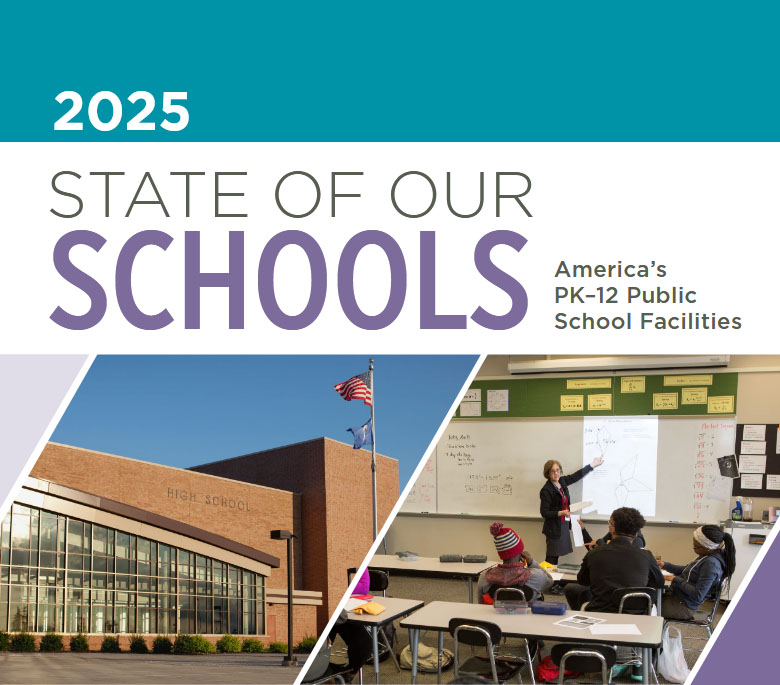
 The 2025 State of Our Schools Report paints a sobering picture: America’s public school infrastructure faces an annual funding gap for modernization of $90 billion.
That number grabs attention. It should.
But here’s the more important question:
If we came up with $90 billion every year… would it actually fix the problem?
The honest answer: Not necessarily.
The D+ That Wouldn’t Move
In 2021, the American Society of Civil Engineers (ASCE) graded K–12 public school infrastructure a D+.
Then came an unprecedented emergency infusion: $160 billion in federal ESSER funding.
Fast forward to 2025.
ASCE’s updated grade for K–12 public schools?
D+.
No improvement.
Some estimates show that as much as 80% of ESSER funds did not go toward infrastructure. But even if only 20% did, that’s still $32 billion invested in facilities.
Are we really saying $32 billion couldn’t move the grade from D+ to even a C-?
That tells us something critical:
The issue isn’t just funding.
The Structural Problem Behind the Structural Problem
Here are the hard truths few want to say out loud:
- Most superintendents were never trained to manage complex infrastructure systems.
- Public schools have been chronically underfunded for decades.
- Deferred maintenance has become normalized.
- Procurement rules were designed to prevent overspending — but they’ve also made large-scale strategic investment extremely difficult.
- The lowest bidder often wins, even when the lowest cost rarely equals the best long-term value.
Add it all together and you get reactive decision-making, fragmented upgrades, and no one truly accountable for long-term performance.
The Real Question: Who Owns the Risk?
What good is investing billions into HVAC systems, ventilation upgrades, controls, roofing, or indoor air quality improvements if:
- There’s no long-term performance accountability?
- There’s no guaranteed maintenance structure?
- There’s no lifecycle cost control?
- There’s no cap on service costs?
Right now:
- Bond buyers don’t know how assets perform after installation.
- Engineering firms design to code and specification.
- District leaders do their best within tight budget constraints.
But no one owns the full lifecycle risk.
And when no one owns the risk, the grade stays D+.
Funding Isn’t Enough. Accountability Is.
If we want real change, funding must come with responsibility.
Capital providers investing in school infrastructure should take on:
- Performance risk
- Maintenance responsibility
- Lifecycle cost oversight
- Long-term service guarantees
When funding and accountability are aligned, incentives change.
When incentives change, outcomes change.
Superintendents can focus on academics instead of emergency mechanical failures. Facility directors can move from reactive repairs to proactive asset management. Budgets become predictable instead of volatile.
A Different Model Is Emerging
This isn’t theoretical.
In the private sector, for over 30 years, performance-backed funding models already existed. Capital is deployed with long-term service contracts, capped maintenance, and asset performance guarantees built into the structure.
That model is now being adapted for public schools.
And it may represent the most viable and sustainable path forward.
The $90 Billion Question — Reframed
The real question isn’t:
“How do we find $90 billion?”
Because capital is not the real constraint.
Through our ESaaS (Energy Savings as a Service) funding platform, we have access to billions of dollars in private capital annually if needed. We do not have to rely solely on unpredictable state budgets, bond cycles, or federal aid packages to modernize school infrastructure.
Moreover, state and federal aid working with ESaaS’s private capital would not only allow for a wider range of modernization projects, but since the ESaaS funding providers are taking on the risks, it would also safeguard both federal and state funds, resulting in what could be the most viable and sustainable funding approach to modernize all of our public schools.
The capital exists.
The real question is:
How do we ensure that every dollar invested improves outcomes, protects assets, and doesn’t leave districts holding the bag five years later?
More money without structural reform will only repeat the cycle.
Smarter capital — capital that transfers performance risk, guarantees maintenance, caps lifecycle costs, and aligns incentives — is what moves grades.
Until funding is paired with accountability, we shouldn’t be surprised when D+ stays D+.
The future of public school infrastructure isn’t just about finding money.
It’s about deploying capital differently.
And doing it in a way that finally changes the outcome.
A Call to Action
This is bigger than one funding model.
This is about changing the trajectory of public school infrastructure in America.
So here’s the challenge:
Every school district leader. Every state facilities official. Every engineering firm. Every ESCO.
Let’s rethink how projects are funded, delivered, and held accountable.
We are not here to compete with engineers. We are not here to replace ESCOs.
Engineers design. ESCOs deliver. Districts lead.
What’s missing is aligned capital — funding providers willing to take on performance risk, assume long-term maintenance responsibility, and stand behind the assets being installed.
With ESCOs, we can strategically partner so their projects include capital providers who are contractually accountable not just for construction, but for lifecycle performance.
Imagine:
- Projects designed by trusted engineers
- Delivered by experienced ESCOs
- Constructed by local community contractors
- Serviced and maintained by local contractors and/or a school’s own maintenance department
- Funded by private capital
- Backed by long-term performance guarantees
- With capped maintenance and aligned incentives
That’s how you move from D+ to something better.
The capital exists. The expertise exists. The workforce exists.
Now we need alignment.
If you’re a superintendent/assistant superintendent of operations/business officials, facilities director, state official, engineer, or ESCO leader who believes school infrastructure deserves a more sustainable model — let’s start the conversation.
Because public school infrastructure won’t improve with more money alone.
It will improve when responsibility follows the capital.
Note: The best ways to reach me are via email at peter@smartairdefense.com, or here on the website to schedule a call.
Anyone interested in reading the 2025 State of Our Schools Report, click on the link.
